In the management of corporate technology, expectations mean little without measurement. When an IT system fails, or a user cannot access applications, the immediate question is always the same: How fast can this be fixed?
The answer lies in a Service Level Agreement (SLA). Far more than a mere formality buried in a vendor contract, an SLA serves as the operational baseline that holds managed service providers accountable, protects corporate budgets, and ensures business continuity.
What is a Service Level Agreement (SLA)?
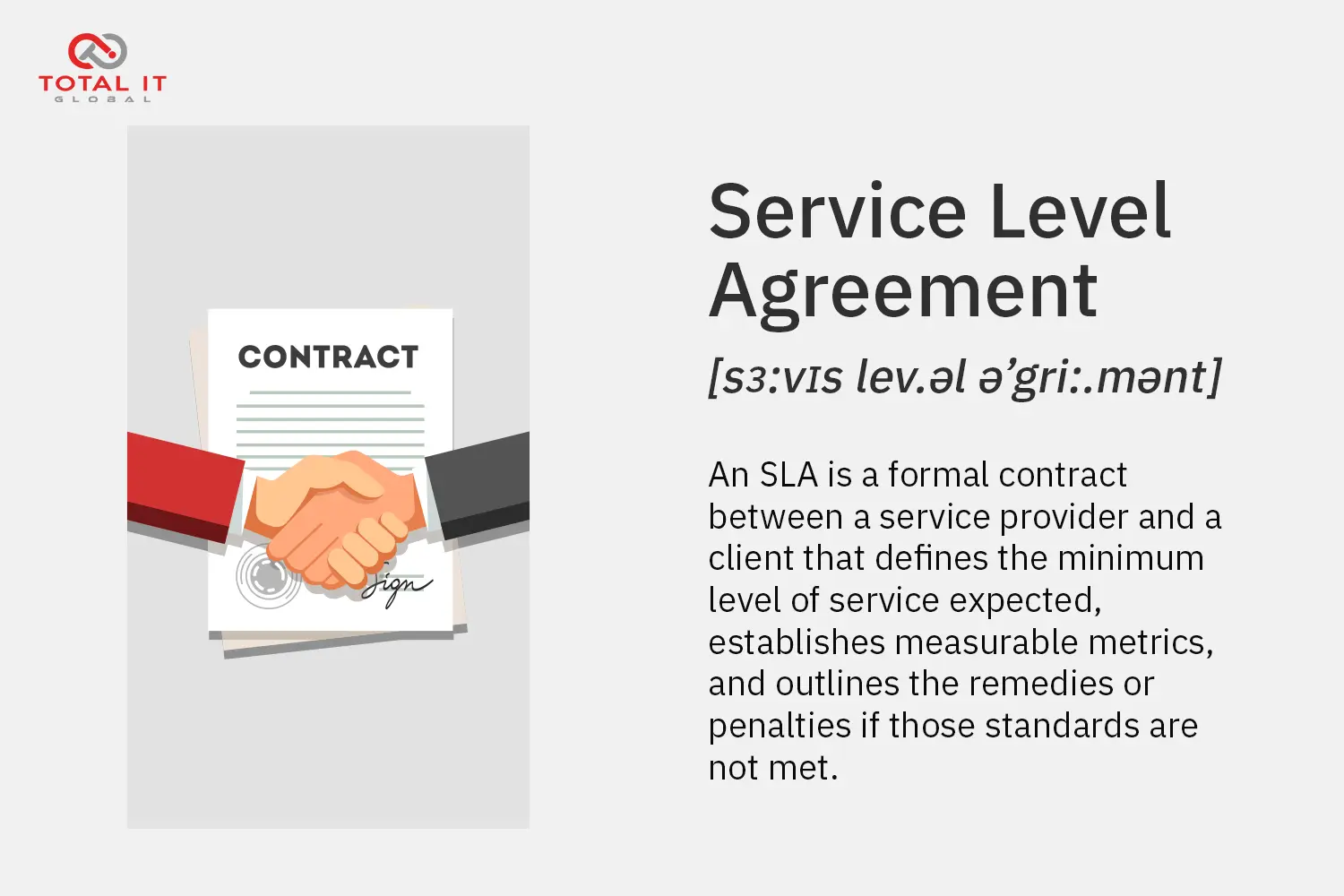
An SLA is a formal contract between a service provider and a client that defines the minimum level of service expected, establishes measurable metrics, and outlines the remedies or penalties if those standards are not met.
Within IT operations, an SLA removes ambiguity. It replaces subjective complaints like “support is too slow” with objective measurements like “critical incidents must receive a verified response within 15 minutes.”
Who provides the SLA?
An SLA originates from the service provider—whether that is an internal enterprise IT department delivering support to business units or an external Managed Service Provider (MSP) managing infrastructure for corporate clients.
The provider drafts the initial agreement based on their operational capabilities, resource availability, and technical frameworks. However, the document is finalised through a collaborative negotiation process with the client or business stakeholders to ensure the commitments realistically match organisational requirements and budget constraints.
Why are SLAs so important?
SLAs are essential for maintaining operational stability and healthy business partnerships. Without them, technology management descends into guesswork and friction. They matter for several critical reasons:
- Aligns Expectations: An SLA establishes a shared understanding of what is possible, eliminating the gap between what a client expects and what an IT team can deliver.
- Drives Accountability: By tying performance to measurable benchmarks, the agreement holds providers responsible for downtime, sluggish response times, or unresolved technical tickets.
- Protects Business Continuity: Structured support windows and escalation paths ensure that critical infrastructure failures receive immediate attention, preventing minor bugs from escalating into major operational halts.
- Enables Objective Evaluation: Reviews transition from emotional arguments over “bad service” to objective data analysis based on logged metrics.
Types of SLAs
Organisations structure their service agreements into three core categories depending on their operational architecture:
- Customer SLA: An agreement tailored specifically to an individual client, a specific business department, or a distinct external group. For example, the finance department might operate under a custom SLA that reflects their heavy reliance on secure, uninterrupted ledger software.
- Internal SLA (Operational SLA): An agreement established between internal departments or teams within the same organisation—such as an internal IT support group and the corporate HR team, or an OLA dictating how L1 frontline staff interact with L2 engineers.
- Multi-Level SLA: A tiered agreement that integrates corporate-level, customer-level, and service-level terms into a single, comprehensive document to govern complex enterprise environments.
Common elements of a Service Level Agreement
A well-structured SLA contains several essential sections that outline the complete lifecycle of the partnership:
- Agreement Overview: Defines the parties involved, the effective dates, and the broad intent of the document.
- Description of Services: Details precisely what IT functions are covered—such as service desk operations, tiered support, or field IT service dispatch.
- Service Level Objectives (SLOs): The specific performance targets, including response times, resolution windows, and uptime percentages.
- Exclusions: Outlines what does not count against performance metrics—such as scheduled system maintenance windows, third-party ISP failures, or force majeure events.
- Security Standards: Specifies data protection protocols, compliance mandates (e.g., HIPAA or GDPR), and access controls.
- Service Tracking and Reporting Agreement: Defines how performance data is collected, how often reports are generated, and how transparency is maintained.
- Penalties: Outlines the agreed-upon consequences if the provider breaches performance targets.
- Termination Processes: Details the conditions, notice periods, and steps required if either party chooses to exit the contract.
- Review and Change Processes: Establishes a schedule (such as quarterly audits) to update the SLA as business needs and technologies evolve.
- Signatures: Formal authorisation from stakeholders and provider leadership confirming acceptance of the terms.
Examples of metrics that SLAs cover
To measure performance objectively, SLAs track specific quantifiable data points:
- First Response Time (FRT): The duration between a user submitting a ticket and a technician acknowledging the issue and beginning initial triage.
- Resolution Time: The total duration from ticket creation to the complete restoration of the IT service.
- First-Time Fix (FTF) Rate: The percentage of incidents resolved during the initial contact or on the first site visit, without requiring secondary escalations or return trips.
- System Uptime and Availability: Expressed as a percentage (such as 99.9% availability), measuring how long critical infrastructure or cloud environments remain operational over a given period.
- Ticket Backlog and Age: Tracking unresolved queues and monitoring outliers that exceed standard SLA thresholds.
How can a client monitor vendor performance against the SLA?
Clients do not have to guess whether a provider is meeting their targets. Performance is monitored through structured mechanisms:
- Automated Ticketing Dashboards: Modern service desk platforms provide real-time dashboards where clients can view live ticket statuses, response times, and active breach warnings.
- Periodic Performance Reports: Providers generate automated weekly or monthly summary reports detailing SLA compliance percentages, total incident volumes, and recurring problem trends.
- Service Review Meetings: Regular quarterly or monthly governance meetings where both teams review report data, discuss operational bottlenecks, and address any near-misses.
What kind of penalties can service providers incur?
When a provider breaches an SLA, the contract typically triggers pre-agreed financial or operational remedies:
- Service Credits: The most common penalty, where the provider refunds a percentage of the monthly management fee or applies a credit toward the next billing cycle.
- Financial Rebates: Direct monetary compensation paid back to the client for severe or repeated downtime violations.
- Corrective Action Plans (CAP): A formal requirement for the provider to submit a root-cause analysis and a strict remediation strategy within a set timeframe.
- Right to Terminate: In cases of chronic, unrectified breaches, the contract permits the client to terminate the agreement without penalty.
What is the difference between SLA and KPI?
While often confused, SLAs and KPIs serve different purposes in IT management:
- Service Level Agreement (SLA): A contractual commitment between a provider and a client. It focuses on external accountability, minimum acceptable standards, and legal remedies if targets are missed.
- Key Performance Indicator (KPI): An internal operational metric used to measure business or technical efficiency. A KPI tracks performance trends (such as average agent handling time or customer satisfaction scores) to help internal teams improve, but missing a KPI does not trigger a legal breach or contract penalty.
Breaking down SLAs by Support Tiers
SLAs vary across different technical layers based on business impact.
| Support Tier | Typical SLA Focus | Typical Response Target | Typical Resolution Target |
| Tier 1 (L1) Helpdesk | High-volume, routine requests (passwords, basic access) | Immediate to 15 minutes | Under 2 hours |
| Tier 2 (L2) Technical Support | Software errors, hardware repairs, workstation fixes | 30 minutes to 1 hour | 4 to 8 hours |
| Tier 3 (L3) Expert Engineering | Architectural issues, database corruptions, core network failures | 1 to 2 hours | 24 to 48 hours (or project-based) |
| On-Site Field Dispatch | Physical hardware swaps, branch office setups, data centre intervention | 2 to 4 hours (geographic dependent) | Same-business-day or Next-Business-Day (NBD) |
Common pitfalls in IT SLAs (and how to avoid them)
Implementing ineffective SLAs can damage vendor relationships or create artificial internal stress. Organisations frequently encounter several common challenges:
- Unrealistic “100% Uptime” Guarantees: No system is entirely immune to failure. Demanding unrealistic guarantees often forces providers to inflate their pricing to cover potential penalties. Aiming for high availability backed by transparent maintenance windows is far more sustainable.
- Ignoring Severity Levels: Treating a password reset with the same urgency as a total data centre outage leads to operational chaos. SLAs must categorise incidents by priority (e.g., P1 for critical business halts, P4 for minor cosmetic requests).
- Failing to Measure and Review: An SLA that sits forgotten in a filing cabinet provides zero value. Regular quarterly reviews ensure that the agreed metrics still align with evolving business goals and technological capabilities.

Conclusion
Service Level Agreements are the operational compass of modern IT management. By replacing guesswork with clear, measurable commitments, SLAs transform IT support from an unpredictable expense into a reliable driver of business productivity.
Total IT Global builds its entire service delivery framework around strict, transparent SLAs ensuring that whether your challenge requires a rapid frontline response, an advanced engineering fix, or a precision on-site dispatch, your business keeps moving forward without interruption.