What Is End of Life (EOL)?
End of Life (or EOL) is the term a manufacturer or vendor uses to indicate that a software product, operating system, or hardware device has reached the end of its commercially viable or support lifecycle.
When a technology asset hits EOL, the vendor officially discontinues active marketing, manufacturing, and regular feature updates. More importantly, it signals the phasing out of technical support, software patches, and security updates, meaning organisations must plan to migrate, upgrade, or decommission the asset.
For enterprise data centres, an EOL applies to core physical infrastructure like servers, storage arrays, networking switches, and enterprise power or cooling systems.
EOL vs. EOSL: A Quick Distinction
While often grouped together, End-of-Life (EOL) and End-of-Service-Life (EOSL) mark two distinct phases in hardware management:
- EOL (End-of-Life): The vendor stops selling, marketing, and manufacturing the product line, though parts, firmware patches, and technical support may still be available temporarily.
- EOSL (End-of-Service-Life): The absolute cutoff point where the manufacturer completely terminates all technical support, firmware updates, and official spare parts production.
(For a deeper look, check out our detailed differences between EOL and EOSL)
The 6 stages of the IT Equipment Lifecycle
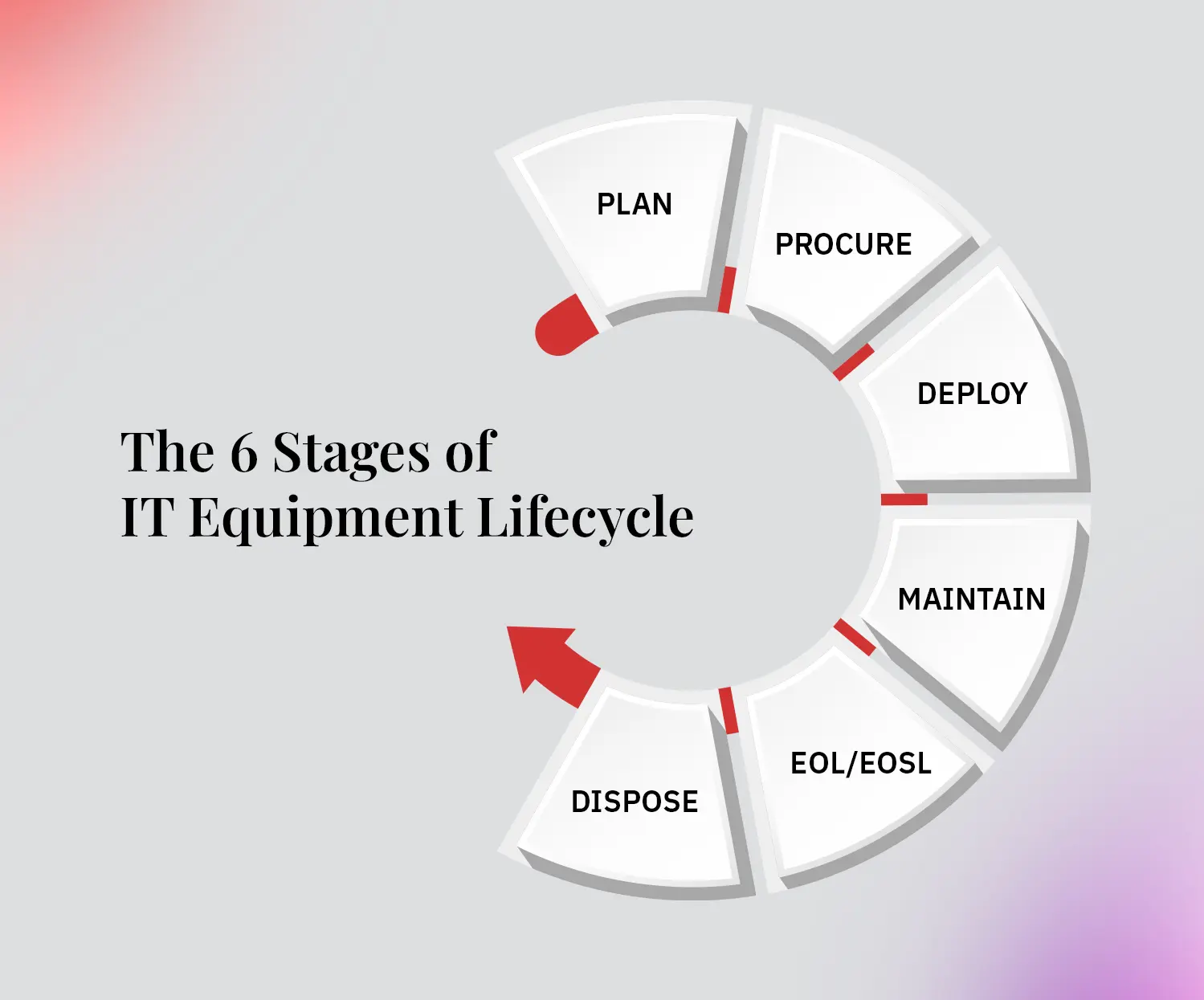
1. Procurement & Planning (Month 0)
Before buying anything, an organisation assesses its technical requirements, budgets, and compatibility with current infrastructure. Devices are chosen based on their expected lifespan and performance requirements.
2. Deployment & Integration (Months 1–3)
The equipment is physically unboxed, asset-tagged for tracking, and installed. IT teams configure the operating systems, push company security policies, install software, and hand the devices over to end-users.
3. Operation & Active Maintenance (Years 1–3)
This is the longest and most productive phase. The equipment is actively used. IT teams perform routine software updates, patch operating systems, monitor performance, and repair physical components (like failing laptop batteries or hard drives) under OEM warranty.
4. End-of-Life (EOL) & Refurbishment (Years 3–5)
The manufacturer officially stops selling the product line. At this stage, the equipment is often reaching the end of its useful accounting lifecycle (depreciation). Organisations start planning their refresh cycles, and some equipment may be reallocated to lower-intensity tasks.
5. End-of-Service-Life (EOSL) (Years 5–7)
The manufacturer stops offering technical support, firmware updates, and official spare parts. Running equipment past its EOSL date introduces immense security and operational risks because software vulnerabilities will no longer be patched.
6. Decommissioning & Disposal (Year 7+)
The equipment is completely retired from service. This stage requires two critical compliance steps:
- Data Destruction: Hard drives and flash storage are completely wiped, degaussed, or physically shredded to protect corporate data.
- E-Waste Recycling: The physical hardware is responsibly recycled or sold to certified IT Asset Disposition (ITAD) vendors to comply with environmental regulations.
Note: Reaching EOL does not automatically mean equipment must be replaced. With the right maintenance strategy, many IT assets can continue operating reliably for years beyond their official EOL date.
Why do Vendors/OEMs declare End of Life?
Vendors and Original Equipment Manufacturers (OEMs) declare End-of-Life (EOL) as a strategic and operational necessity. While it often feels like a forced upgrade to consumers, it is driven by business realities across engineering, finance, and supply chains.
The primary reasons OEMs declare a product EOL include:
1. The High Cost of “Technical Debt” & Resource Shift
Maintaining legacy codebases or hardware requires massive engineering, testing, and customer support capacity.
- Engineering Focus: Every hour an engineer spends writing patch code for a 10-year-old operating system is an hour they aren’t spending innovating the company’s next-generation product.
- Staffing Scarcity: Over time, technicians who understand legacy code or architecture retire or move on. It becomes highly inefficient to train new personnel on outdated systems.
2. Supply Chain & Component Obsolescence
Hardware OEMs rarely build 100% of their devices from scratch. They rely on global part suppliers.
- Foundry Changes: If an external semiconductor foundry shuts down an old microchip processing line to make room for faster, more profitable chips, the OEM can no longer source the parts to build their device.
- Scarcity of Materials: Raw materials or specialised capacitors disappear from the market, making continued manufacturing impossible or prohibitively expensive.
3. Safety and Architecture Limitations
As technology evolves, old architecture becomes structurally incapable of defending itself against modern cybersecurity threats.
- Inherent Insecurity: Some legacy tech was built before modern cyber-threat models existed. Patching them is like trying to put a bulletproof vest on a cardboard box; the underlying foundation is simply too fragile to secure.
- Incompatibility: Old systems cannot integrate with modern cloud APIs, faster internet speeds, or advanced storage technologies, making them a bottleneck for the systems around them.
4. Financial & Market Realities
Ultimately, OEMs are businesses driven by profitability and shareholder expectations.
- Declining Demand: When sales for an older model drop below a sustainable profit margin, continuing production loses money.
- Driving Upgrades: Sunseting old versions subtly encourages enterprise networks and consumers to refresh their environments, thereby stimulating a new stream of revenue for the vendor.
What happens when an asset reaches EOL?
When an IT asset officially reaches its End-of-Life (EOL) milestone, the transition does not happen all at once. Instead, it triggers a shift in how the manufacturer treats the product and brings direct operational changes for businesses relying on that infrastructure.
After a product’s EOL date, the manufacturer gradually ceases:
- System and security updates
- Bug fixes
- Technical support services
This transition often introduces Third-Party Maintenance (TPM) providers into the asset lifecycle. Because original equipment manufacturers (OEMs) phase out official support, organisations frequently turn to TPM alternatives to keep legacy hardware running past its cutoff date.
However, running unsupported, legacy IT systems without proper patch management or maintenance structures carries massive commercial risk. A stark example of this is the landmark 2017 data breach at Equifax. The multi-billion-dollar breach, which exposed the personal data of over 147 million people, was traced back to an unpatched vulnerability in a legacy dispute-portal system. Because the system was outdated and overlooked during security patching cycles, regulators hit Equifax with a historic $575 million settlement (and total costs exceeding $700 million) for relying on fragile, unpatched legacy IT infrastructure.
Beyond catastrophic security breaches, sticking with unmanaged EOL hardware triggers immediate operational penalties:
- Cessation of Security Patches and Support: Vendors stop releasing vulnerability fixes and official help desks close, leaving newly discovered security flaws permanently open and internal teams without vendor troubleshooting resources.
- Costly Component Repairs: Sourcing rare, discontinued physical parts drives up maintenance expenses exponentially.
- Incompatibility Issues: Newer software releases, operating systems, and hardware peripherals drop support for the EOL platform, leading to severe integration failures.
- Compliance and Audit Failures: Operating outdated, unpatched hardware routinely violates rigorous industry regulatory standards, data privacy frameworks, and cyber insurance policy requirements.
Financial Trade-offs: TPM Contracts vs. Full Replacement
When hardware reaches EOL, organisations face a major financial balancing act between capital expenditure (CapEx) and operational expenditure (OpEx). Committing to a total hardware refresh requires heavy upfront capital to buy new servers or storage arrays. Conversely, partnering with a Third-Party Maintenance (TPM) provider allows businesses to extend equipment lifespans under flexible OpEx contracts.
However, for regulated or high-risk industries such as financial services, insurance, and healthcare, maintaining asset compliance is non-negotiable. In these sectors, regulatory bodies and auditors often expect direct asset replacement upon EOL to eliminate compliance risks, meaning extended maintenance strategies are legally or operationally unviable.
Software EOL vs. Hardware EOL
While both fall under the EOL umbrella, they manifest differently:
- Software EOL: Usually follows a defined lifecycle (such as Microsoft’s Support Lifecycle). Once reached, the software continues to run, but running it exposes networks to severe security vulnerabilities because zero-day exploits go unpatched.
- Hardware EOL: Means the physical components are no longer manufactured. Sourcing replacement power supplies, motherboards, or storage drives becomes difficult and expensive, sharply increasing the risk of sudden mechanical failure.
How organisations manage EOL assets
To prevent operational disruptions and security breaches, IT teams implement structured EOL asset management:
- Lifecycle Tracking: Maintaining an inventory management system that logs purchase dates, warranty periods, and official vendor EOL schedules.
- Migration Planning: Upgrading software or replacing physical hardware well before the official EOL date arrives.
- Extended Support Contracts: Purchasing third-party extended security updates as a temporary bridge if immediate migration is not feasible.
- Secure Decommissioning: Wiping, recycling, or safely disposing of retired hardware in compliance with environmental and data privacy regulations.
Conclusion
End of Life (EOL) is an inevitable milestone in the technology lifecycle. Left unmanaged, EOL assets introduce severe security vulnerabilities, compliance failures, and unexpected downtime. By tracking lifecycles proactively and partnering with experienced infrastructure management teams like Total IT Global, organisations can smoothly transition away from legacy systems and keep their technical environments secure and resilient.