What is a Field Technician?
A field technician is a specialised professional who travels to client sites or remote facilities to install, maintain, and repair technical equipment and systems, including hardware and software problems.
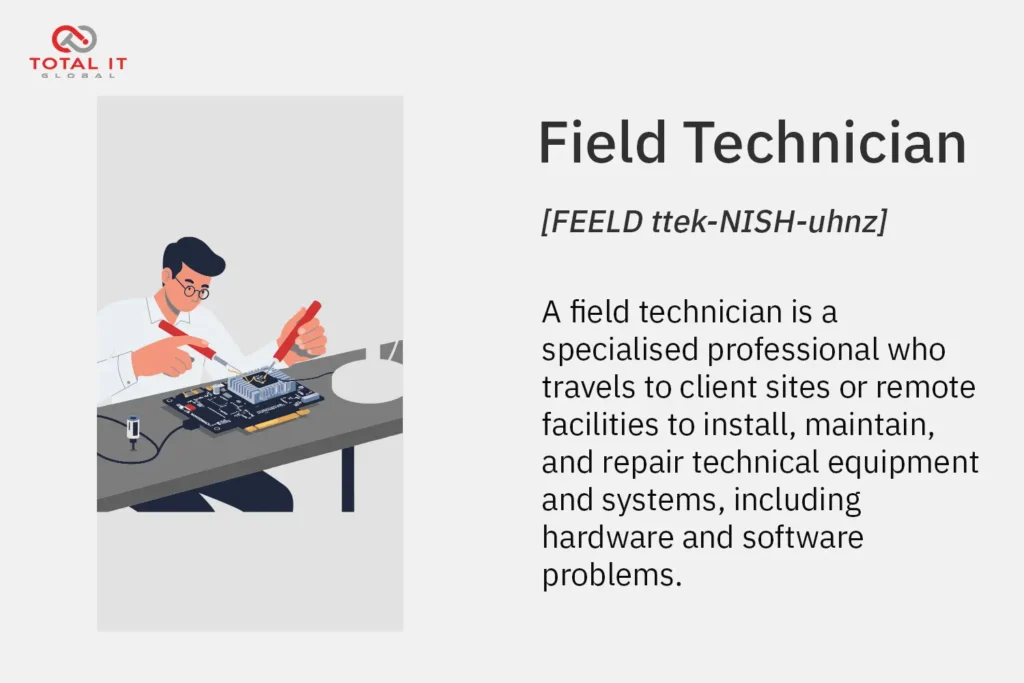
Field technicians handle tangible equipment and localised environmental conditions directly on-site, unlike desk-bound support staff who diagnose problems through remote desktop tools. Their remit spans multiple technical disciplines depending on the industry, ranging from telecommunications and IT infrastructure to medical devices, industrial manufacturing machinery, and smart-grid energy networks.
What are the responsibilities of a Field Technician?
The day-to-day responsibilities of a field technician span a mix of technical work, physical labour, administrative documentation, and face-to-face customer service. Because they act as the primary, on-site link between a company and its clients, their duties are highly varied.
1. Equipment Installation and Provisioning
When a client purchases new infrastructure, technology, or hardware, the field technician handles the deployment from start to finish.
- Site Assessment: Evaluating the physical environment to check for proper wiring, ventilation, dimensions, and power supplies before setting up equipment.
- Assembly & Integration: Physically installing hardware and linking it with the client’s existing digital networks, software, or utility systems.
- Testing & Configuration: Running baseline diagnostics and rigorous stress tests to ensure everything operates within vendor specifications.
- Handover Sign-off: Walking the customer through a functional demo to secure operational approval before leaving.
2. Diagnostics, Troubleshooting, and Emergency Repairs
When a critical system fails, field technicians are dispatched to minimise customer downtime and resolve the issue.
- Root-Cause Analysis: Using diagnostic software, meters, and blueprints to identify the exact cause of a mechanical, electrical, or software failure.
- Component Replacement: Swapping out broken or worn parts, wiring, or circuitry safely and efficiently.
- Escalation Management: Knowing when a problem requires advanced engineering intervention and escalating it with structured notes to tier-3 support teams.
3. Proactive Preventative Maintenance
To stop breakdowns before they happen, technicians manage scheduled service contracts.
- Routine Servicing: Performing mandated tasks like cleaning components, calibrating internal lasers or gauges, and upgrading firmware.
- Wear Analysis: Tracking the degradation of machinery parts to recommend pre-emptive component replacements.
- SLA Compliance: Executing scheduled checks within precise windows required by Service Level Agreements (SLAs).
4. Client Communication and Training
Because field technicians work directly on client property, good communication skills are just as vital as technical expertise.
- Simplifying Technical Speech: Explaining what went wrong and how it was fixed without confusing the client with intense industry jargon.
- User Training: Educating customer teams on best practices for operating the machinery to avoid future user-error issues.
- Upselling Guidance: Informing customers about complementary products, newer models, or upgraded service plans that could prevent future operational pain points.
5. Documentation, Fleet, and Logistics Management
A massive portion of a technician’s day involves back-end administrative upkeep using Field Service Management (FSM) applications.
- Work Order Completion: Submitting comprehensive digital job cards, documenting labour hours, tracking serial numbers, and logging exact issues.
- Inventory Control: Tracking the inventory inside their service vehicle and requesting replenishment parts through automated dispatch channels.
- Safe Fleet Operation: Operating and maintaining corporate vehicles safely while using GPS and route optimisation tools to hit tightly scheduled appointments.
6. Safety, Standards, and Regulatory Compliance
Technicians often work around high-voltage electricity, complex machinery, or hazardous environments.
- Risk Assessments: Conducting immediate safety audits at a job site before beginning work to ensure optimal environmental controls.
- PPE and OSHA Enforcement: Routinely utilising personal protective equipment (PPE) and following local safety guidelines (like OSHA or regional equivalents).
What skills do you need to be a Field Technician?
To excel as a field service technician, an individual needs a balanced mix of technical proficiency, hands-on mechanical capabilities, soft skills, and physical adaptability. Because these professionals operate independently at client sites, they must be as good with people as they are with machines.
The essential skills are broken down by category below:
Technical & Engineering Skills
These foundational capabilities allow technicians to understand, diagnose, and repair complex systems:
- Troubleshooting Methodology: Deep theoretical and practical understanding of systemic failure analysis, allowing them to comprehend how complex hardware, software, and electrical loops interact when a breakdown occurs.
- Blueprint & Schematic Literacy: Reading and interpreting complex wiring diagrams, engineering blueprints, architectural layouts, and technical manuals.
- Diagnostic Equipment Mastery: Comprehensive knowledge of how specialised testing instruments, such as digital multimeters, oscilloscopes, and protocol analysers, interpret electrical signals, continuity, and data transmission.
- Digital Literacy: Using modern Field Service Management (FSM) software on mobile devices to log work orders, track inventory, and look up equipment history.
Core Soft Skills
Because field technicians directly represent their company to the client, interpersonal skills are vital for customer retention:
- Active Listening & Empathy: Welcoming frustrated clients, listening to their descriptions of the equipment failure, and reassuring them that the problem will be handled.
- Translating Technical Jargon: Explaining highly complex electrical or mechanical issues in simple, everyday language that the client can easily understand.
- Conflict Resolution: Safely and professionally handling tense situations when a client is upset about equipment downtime or unexpected service costs.
Operational & Adaptability Skills
Field technicians essentially run their own mobile businesses out of a service van, requiring strong self-management:
- Time Management & Autonomy: Punctually managing a daily schedule of multiple appointments, optimising driving routes, and working productively without direct supervision.
- Safety & Regulatory Compliance: Strict adherence to safety protocols, including OSHA standards, Lockout/Tagout (LOTO) procedures, and the correct use of Personal Protective Equipment (PPE).
- Inventory Control: Keeping a meticulous log of the spare parts, tools, and components stocked inside the service vehicle to avoid arriving at a job empty-handed.
Physical Attributes
The physical demands of field service require a high baseline of stamina and dexterity:
- Gross & Fine Motor Dexterity: Manipulating tiny components, splicing delicate wires, and precisely calibrating sensitive sensors.
- Physical Stamina: Being comfortable lifting heavy equipment (often up to 23 kg/50 lbs), climbing ladders, crawling into tight crawlspaces, and standing for long stretches.
- Environmental Tolerance: The ability to work efficiently in diverse and harsh environments, ranging from freezing outdoor telecom towers to sweltering industrial factories.
What is the difference between a Field Service Technician and an Engineer, or are they the same?
While titles often merge in casual corporate conversation, a distinct operational boundary separates a field service technician from a field service engineer. However, in many fast-moving environments, their daily realities frequently overlap.
Where their roles converge
On the front lines of customer service, technicians and engineers often share the same immediate mission: restoring failed infrastructure as quickly as possible. During high-stakes outages, both roles require hands-on troubleshooting, physical hardware handling, direct client communication, and the ability to work independently under pressure. In smaller enterprises or leaner support teams, a single field professional often carries out both tactical break-fix repairs and advanced architectural configurations.
Where their paths diverge
Comparing them across core pillars reveals how enterprises deploy these roles when specialisation is required:
- Skills and Qualifications:
- Technician: Typically holds vocational qualifications, trade certifications, or associate degrees in electronics, IT support, or telecommunications. Their expertise centres on applied mechanics, component swaps, diagnostic tool handling, and following structured troubleshooting flowcharts.
- Engineer: Generally holds a bachelor’s degree in engineering (electrical, mechanical, or computer science) or advanced professional certifications. They possess deep theoretical knowledge, enabling them to comprehend complex circuit designs, software-hardware interactions, and architectural systems.
- Responsibilities:
- Technician: Focuses primarily on break-fix execution, routine preventative maintenance, physical hardware swaps, component replacements, and standard installations.
- Engineer: Handles advanced diagnostic analysis, complex system integrations, architectural troubleshooting, root-cause investigations for recurring faults, and custom modifications on highly specialised or proprietary machinery.
- Team Interaction and Duties:
- Technician: Acts as the primary frontline responder for scheduled dispatches and standard break-fix tickets. They collaborate closely with help desk coordinators and dispatchers to close routine work orders.
- Engineer: Often operates as a second-line escalation point. When a technician encounters an unresolvable systemic failure in the field, an engineer steps in to untangle underlying architecture, often guiding junior staff or liaising directly with product development teams to resolve deep technical anomalies.
What challenges do they face in the Field?
Despite the autonomy and problem-solving satisfaction of the role, field technicians frequently navigate distinct operational friction points:
- The “First-Time Fix Rate” Pressure: Balancing speed with precision; arriving on-site without the correct replacement part or diagnostic tool forces costly repeat visits.
- Unpredictable Environments: Working in cramped, poorly lit, excessively hot, or freezing conditions while maintaining high concentration levels.
- Legacy and Unmapped Infrastructure: Encountering undocumented cable runs, outdated proprietary hardware, or messy patch panels left behind by previous contractors.
- Logistical Bottlenecks: Dealing with traffic delays, supply chain shortages for spare parts, and shifting priority schedules assigned by central dispatch.
How has Technology changed the Role?
Managing field operations has undergone a massive digital transformation over the last decade. Historically, technicians relied on paper work orders, landline check-ins with dispatchers, and physical manuals carried in the boot of a van.
Today, field service management (FSM) software connects technicians directly to real-time inventory databases, customer history logs, and remote engineering teams. Armed with ruggedised tablets, mobile dispatch apps, and augmented reality remote assistance tools, technicians can pull up schematics, order replacement parts on the fly, and consult with senior specialists across the world while standing in front of a complex wiring cabinet.

Conclusion
Field technicians are the unsung heroes of modern technical infrastructure. Without them, the cloud remains unanchored, enterprise networks remain isolated, and digital transformation grinds to a physical halt. By partnering with Total IT Global, organisations gain access to agile global field support, robust dispatch software integrations, and continuous technical training that empowers field teams to solve complex problems faster and keep the physical world reliably connected.