Your core switches run completely stable, your access layers hum along without issue, and yet your inbox fills up with another steep, non-negotiable renewal quote from the manufacturer.
Welcome to the lifecycle trap of enterprise networking support.
For IT leaders managing large fleets of Cisco infrastructure, relying solely on traditional original equipment manufacturer (OEM) contracts drains budgets for hardware that no longer requires active software development. Enter Third-Party Maintenance (TPM), an alternative that shifts control back to internal teams, slashes maintenance overhead, and breaks the cycle of forced hardware refreshes.
What Is Cisco Third-Party Maintenance?
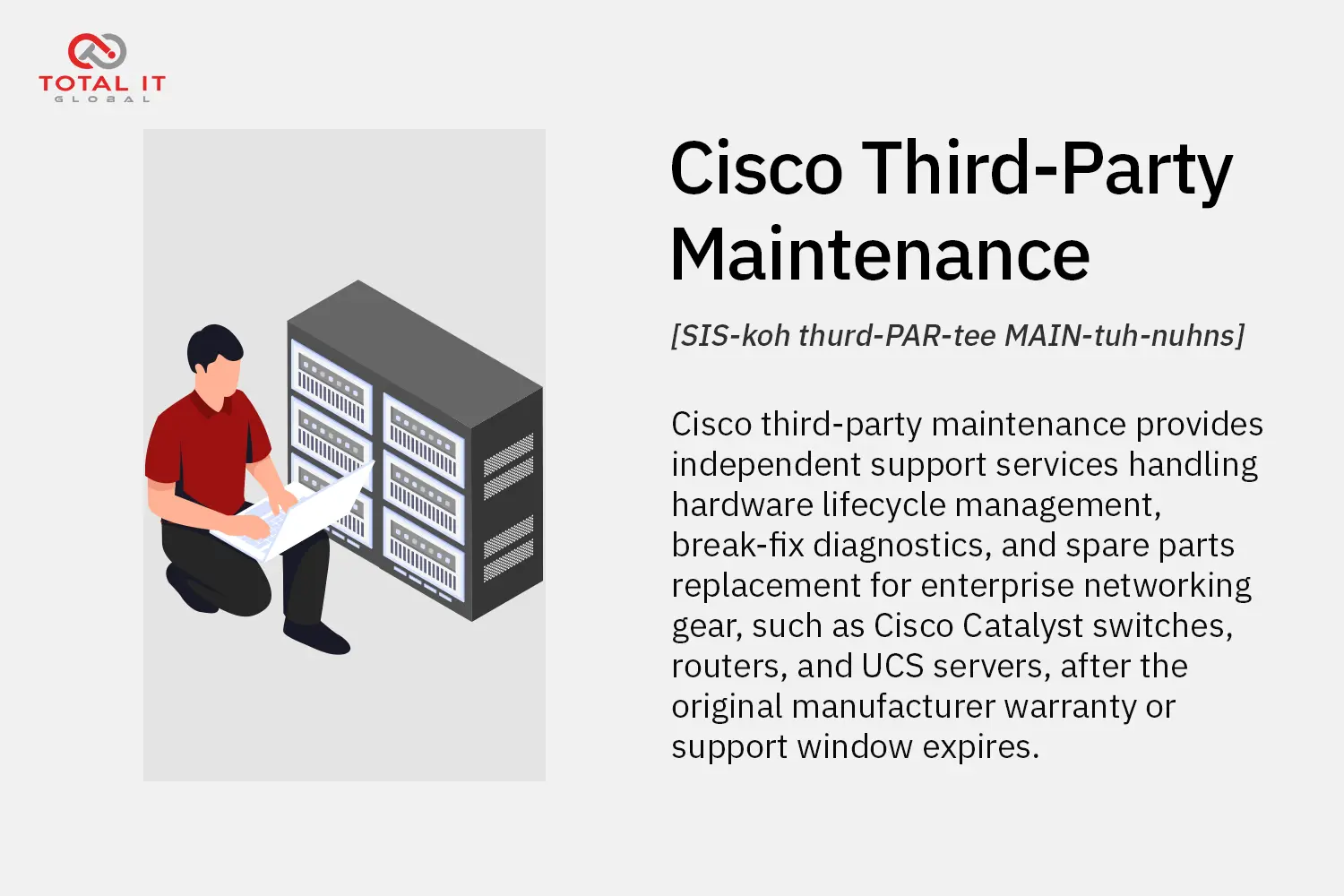
Cisco third-party maintenance provides independent support services handling hardware lifecycle management, break-fix diagnostics, and spare parts replacement for enterprise networking gear, such as Cisco Catalyst switches, routers, and UCS servers, after the original manufacturer warranty or support window expires.
Instead of tying service agreements directly to Cisco’s rigid corporate policies and End-of-Life (EOL) or End-of-Support-Life (EOSL) timelines, TPM providers focus strictly on keeping existing hardware running reliably, efficiently, and securely.
For a broader foundational breakdown of how these independent models function across enterprise hardware, explore our detailed blog on Third-Party Maintenance.
Services Provided by TPM
A comprehensive third-party maintenance agreement for Cisco environments covers the full operational lifecycle of enterprise hardware:
- 24/7 Helpdesk and Remote Diagnostics: Round-the-clock access to technical assistance centres where engineers triage alerts, analyse log files, and remotely isolate hardware faults.
- Flexible On-Site Break-Fix Support: Dispatching qualified field engineers directly to data centres or local offices to replace faulty power supplies, fan trays, supervisor engines, or interface modules.
- `Spare Parts Logistics and Depots: Maintaining geographically distributed parts hubs loaded with certified Cisco replacement hardware, component delivery aligned with committed service level agreements (SLAs).
- Proactive Hardware Monitoring and Diagnostics: Integrating with network management tools to catch early indicators of hardware degradation before a failure occurs.
- Asset Management and Lifecycle Auditing: Cataloguing serial numbers, tracking firmware states, mapping contract end dates, and providing complete visibility across multi-site inventories.
- Secure Hardware Decommissioning and Recycling: Handling secure data wiping, asset recovery, and environmentally responsible recycling when equipment reaches its terminal operational stage.
Benefits of Cisco Third-Party Maintenance
Transitioning stable or post-warranty Cisco assets to a reputable TPM provider yields distinct operational and financial advantages:
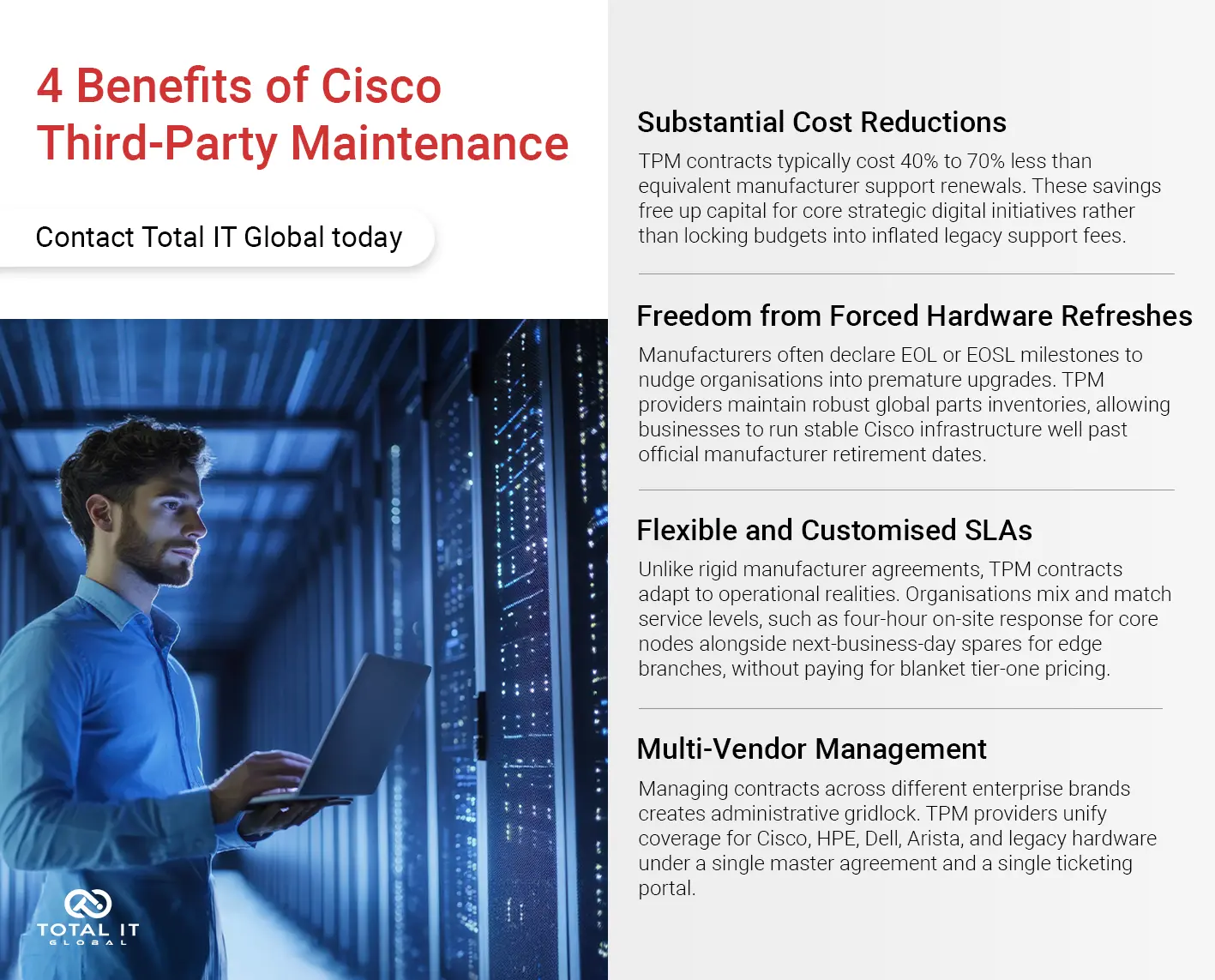
- Substantial Cost Reductions: TPM contracts typically cost 40% to 70% less than equivalent manufacturer support renewals. These savings free up capital for core strategic digital initiatives rather than locking budgets into inflated legacy support fees. Read more about the Benefits of Third-Party Maintenance.
- Freedom from Forced Hardware Refreshes: Manufacturers often declare EOL or EOSL milestones to nudge organisations into premature upgrades. TPM providers maintain robust global parts inventories, allowing businesses to run stable Cisco infrastructure well past official manufacturer retirement dates.
- Flexible and Customised SLAs: Unlike rigid manufacturer agreements, TPM contracts adapt to operational realities. Organisations mix and match service levels, such as four-hour on-site response for core nodes alongside next-business-day spares for edge branches, without paying for blanket tier-one pricing.
- Multi-Vendor Management: Managing contracts across different enterprise brands creates administrative gridlock. TPM providers unify coverage for Cisco, HPE, Dell, Arista, and legacy hardware under a single master agreement and a single ticketing portal.
- Direct Access to Senior Engineering Expertise: Rather than navigating multi-tiered support queues with scripted responses, TPM clients gain direct access to senior Level 3 engineers who understand complex, heterogeneous network architectures.
- Reduced Environmental Impact (Sustainability): By extending the operational lifespan of existing Cisco hardware, enterprises delay premature e-waste generation, lower Scope 3 carbon emissions associated with manufacturing new devices, and significantly improve their Total Cost of Ownership (TCO).
The Hybrid Maintenance Strategy
Smart IT management rarely requires an all-or-nothing approach. Many experienced infrastructure teams deploy a hybrid support model to balance security compliance with aggressive cost optimisation:
- Keep Mission-Critical Core Devices on OEM Support: Retain manufacturer coverage for core routing and switching backbones where continuous access to zero-day firmware updates and active vulnerability patches remains mission-critical.
- Offload Stable Edge and Access Gear to TPM: Shift access-layer switches, branch office routers, and stable post-warranty hardware to a trusted third-party maintainer to capture immediate budget relief.

Conclusion
Third-party maintenance is a mature, enterprise-grade strategy for optimising infrastructure lifecycles. By partnering with Total IT Global, enterprises gain access to a rigorous multi-vendor support framework and expert engineering teams dedicated to extending hardware ROI.
Aligning support costs with actual operational needs rather than manufacturer sales targets allows organisations to eliminate unnecessary waste, reduce e-waste footprints, and maintain absolute control over their network architecture.